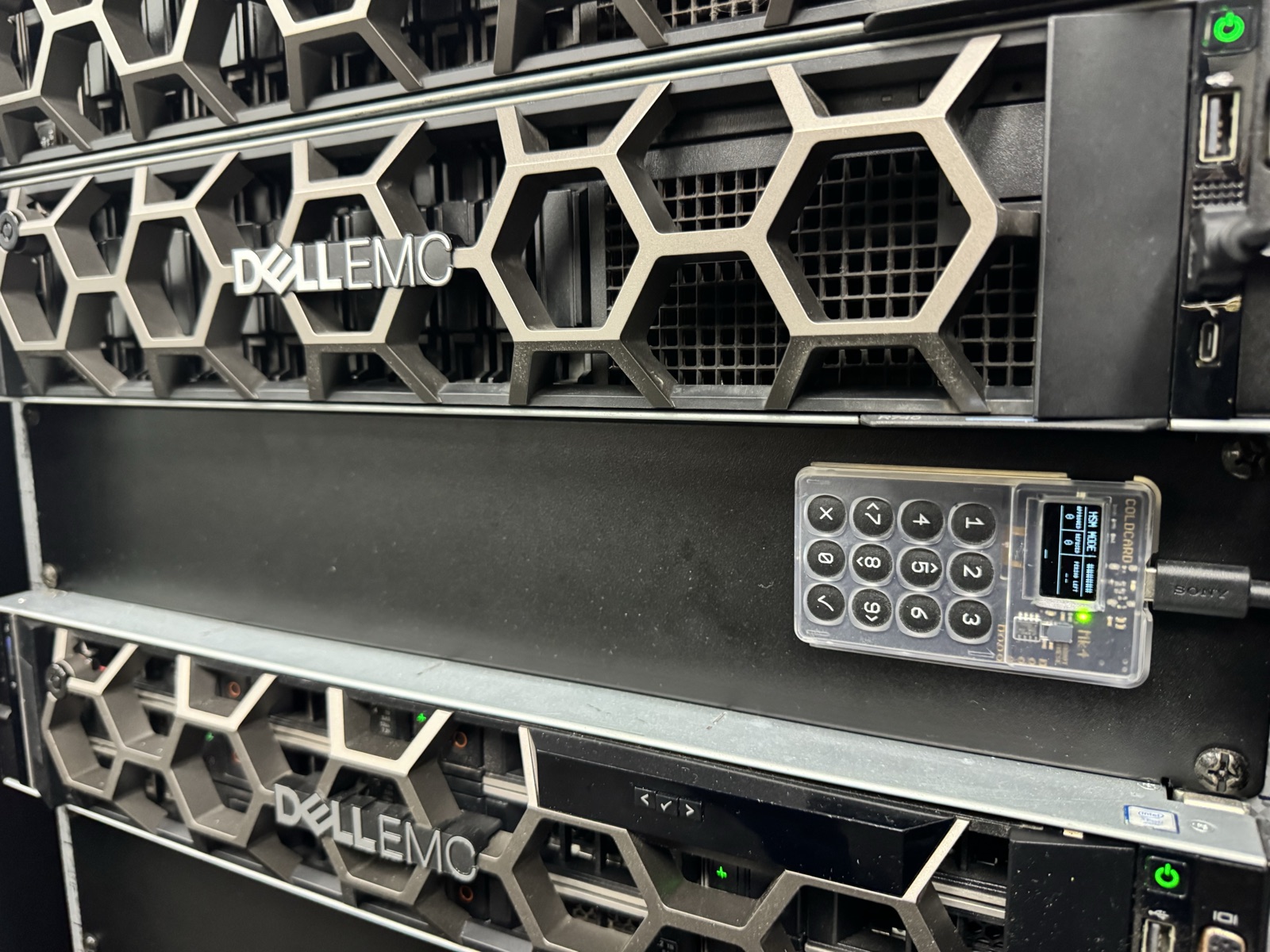
This project selected Coldcard because it was the only mainstream hardware wallet
with a genuine HSM mode — which is why Coldcard is named throughout this document.
Our standing advice has always been to generate seeds outside the hardware
device, using a robust, auditable entropy source such as Entropia.
Any customer who implemented multisigHSM to our best-practice standard would not
be exposed by this advisory.
Even so, we can no longer support the use of Coldcard in any form of custody
setup. If you hold funds under a seed generated on a Coldcard, move them to a
different custody setup, using a seed generated on hardware you still trust.
multisigHSM will return with a different HSM solution. Everything that
follows describes the architecture, which is unchanged — only the signing hardware
it was built on is withdrawn.
mineracks
Self-hosted bitcoin infrastructure · Brisbane
distributed · policy-enforced · multisig HSM
Your treasury refills itself. By your rules, on your keys.
An exchange keeps a few percent of funds hot. The rest sits in cold storage — until it
moves to top the hot wallet back up. That refill is the largest, least-automated transaction your business
makes, and today it runs on one of two shaky foundations: a manual signing ceremony, or a custodian who
holds your keys.
The hot wallet is the small target.
You already rate-limit it, monitor it, and accept it can be drained. The catastrophic loss is the
cold reserve behind it — and the only time it's reachable is the moment it opens to refill the hot side.
Every refill is a ceremony or a custodian.
Either people hand-sign with hardware wallets under time pressure when the hot wallet runs dry, or a
SaaS custodian signs for you. One is slow and error-prone; the other isn't your keys.
“
An attacker doesn't need your hot wallet. They need the moment your cold wallet opens to fill it —
and they need that moment to be governed by software they can reach, not hardware you hold.
The gap the multisig HSM closes
Real hardware. A Coldcard in HSM mode, signing on a host in the rack — one of three independent signers.
01
why an HSM · and why it must be multisig
A hacked server drains a hot wallet almost every year.
Putting a signing key on an internet-connected server is the bet exchanges keep losing — it is the single most common way custodial Bitcoin is stolen. Since 2012, there has been a hot-wallet/server drain in nearly every year.
A loss in nearly every year — on the order of ~1,000,000 BTC in total, concentrated in Mt. Gox (~750k) and Bitfinex (~120k). Mixed-asset hacks show the Bitcoin portion; values priced at the time, disputed figures given as ranges. Sources →
1 · So: an HSM
Keep the signing key on tamper-resistant hardware it can never leave. A fully-owned server still can't extract it — the most-exploited failure mode is gone.
2 · One isn't enough
A single device on a single host is still a single point: own that one box, or coerce that one operator, and it signs. The bottleneck moved, it didn't vanish.
3 · So: a multisig HSM
2-of-3 across independent hosts, each enforcing its own policy. No single hacked server or insider moves funds — and any one signer can fail without freezing the rest.
02
The refill problem
Two bad options, every single refill.
The cold→hot refill is where sovereignty, automation and policy collide — and today you
get to pick two at most. Here's what's actually on the table.
Option A · do it yourself
Manual cold multisig.
Secure keys — but a human ritual.
People, hardware wallets, a room and a checklist — often at 3am when the hot wallet drains
Can't run unattended; doesn't scale with volume or staff turnover
Every signer sees and approves by hand — slow, and irreversible if they get it wrong
Key-holders become the bottleneck and the insider-risk surface
You hold the keys. You also hold the pager.
Option B · hand it off
Custodial / MPC platform.
Automated and fast — but not your keys.
The platform's software holds (a share of) the signing keys — you're trusting their stack
Their SOC2, their insurance, their breach response — their compromise becomes yours
Basis-points on reserves, forever; pricing built for institutions, not sovereignty
Policy lives in a vendor console you don't control and can't fully audit
Fast and hands-off — by giving up custody of the bulk of your funds.
“
Nobody ships all three at once: automation, hardware
keys you physically hold, and policy that can't be overridden in software.
That's the whole reason this exists.
What's missing from both options
03
The mineracks approach
A cold tier that signs its own refills — by policy, no human.
Three independent hardware signers — Coldcards in HSM mode — each on a separate host, ideally
a separate site. A keyless coordinator builds the refill transaction and fans it to any two. They check it
against their own on-device rules and auto-sign. The signed refill broadcasts to your hot wallet. No human in
the loop — and no single machine can move a satoshi.
Every refill gated on the hardware
A per-transaction cap, a velocity limit (max per hour/day), and an address whitelist that allows
only your own hot-wallet deposit addresses. Break a rule and the secure element refuses to sign —
no software path around it.
No single point of compromise — or failure
2-of-3 across separate hosts and sites. Own one signer and you move nothing. Lose one signer to a
reboot, outage or dead device and refills carry on. Lose two and funds simply freeze — safe.
Keys you hold · a coordinator that holds none
The automation layer carries no keys, so its compromise can't move funds. The rules and the signing
live on the Coldcards' secure elements. The coordinator only proposes; the hardware decides.
Need a bigger, one-off move? A human-gated surge.
Everyday refills run untouched — no human involved. When you deliberately want a larger spend, the owner enters a one-time code from a normal authenticator app, and only then will 2-of-3 sign above the everyday cap — still bounded by a separate on-device surge ceiling the coordinator can't exceed. The coordinator merely relays your code; the secret never leaves the Coldcards and your phone. Automation for the routine, a deliberate human gate for the exceptional.
An automated refill, start to finish
Step 1Trigger
Hot wallet low
Balance falls below your floor — automatically detected
Step 2Propose
Keyless build
Coordinator drafts the refill PSBT from a watch-only wallet
Step 3Sign
Any 2 of 3
Two Coldcards check policy & auto-sign — no human
Step 4Refill
Broadcast
Signed top-up lands in your hot wallet on-chain
Don't take our word for it — a working 2-of-3 runs on real Bitcoin signet at
multisighsm.com. Every policy decision and transaction is inspectable on a public explorer.
04
Security model · for the reviewer who asks "what if it's breached?"
Assume the server is owned. Now what?
Every serious custody review reduces to one question: what happens when a server is
compromised, an operator goes rogue, or a data centre dies? Here's the honest answer, failure by failure.
Coordinator fully compromised
Can't steal — bounded by hardware.
Holds no keys — can't sign or forge; every spend still needs two Coldcards
Can't send off your whitelist — at worst it refills your own hot wallet early
Can't exceed the devices' velocity ceilings — the hard catastrophic bound
Worst case is a capped, premature refill of your own addresses — not a theft.
Signer host(s) compromised
One moves nothing; two must beat the silicon.
Own one host → zero: it needs two, and the key never leaves the secure element
Own two → still capped by each device's on-device cap + velocity + whitelist
An attacker must defeat two independent secure elements, not two Linux boxes
The host is a courier; the policy and the key live on the chip.
A host — or a whole site — lost
Lose one, keep running; lose two, freeze safe.
2-of-3 across independent failure domains, ideally one offsite
Any one signer down (outage, reboot, dead device) → refills continue
Two down → funds freeze, never stolen — and resume when one returns
No single outage stops you; no single breach moves funds.
No single point to attack or lose
The limit is derived from the chain.
The global velocity cap is computed from the blockchain, not one server's file
Any coordinator replica recomputes it — nothing to corrupt, nothing to lose
Replicas run across the same independent sites as the keys
There's no one box whose failure or tampering changes the answer.
The math is bounded — on purpose.
We show our working: a fully-compromised coordinator can move at most 1.5× a single signer's
per-period velocity ceiling (two signatures burned per unit of value). Set each ceiling to
two-thirds of your chosen limit and the worst case equals that limit — enforced on
hardware, not software.
05
How it compares
Where it fits — and where it doesn't.
Honest positioning beats a feature grid. Here's how the distributed policy HSM lines up
against the options exchanges actually use to guard reserves and refill the hot side.
Approach
Keys you physically hold
Runs unattended
Policy on the hardware
No vendor to trust
Cost
Single hot-wallet signer one server signs everything
~
✓
✗
✓
low
Manual cold multisig humans sign with hardware wallets
✓yes ✗no ~partial / depends — Coldcard® is a trademark of Coinkite; other names belong to their owners.
The honest part: we don't replace your hot-wallet engine.
High-throughput hot signing — hundreds of withdrawals an hour — is what MPC clusters are built for,
and we'll tell you to keep using one there. A hardware signer isn't a certified, high-TPS appliance, and
we don't pretend otherwise. What mineracks secures is the cold and warm tiers — the 95% of reserves
and the refill pipe between them: low-throughput, high-stakes, and exactly where automation with
hardware keys you hold beats both a 3am ceremony and a custodian. Cheaper than Fireblocks for the bulk of
your funds, and sovereign by construction.
Automate the refill. Hold the keys.
See a live 2-of-3 sign real-signet refills under policy → multisighsm.com